
Wheels Are Live — One Campaign, Not Five Unrelated Trades
I've been running wheels on NVDA for about eighteen months. It is my single most profitable strategy. And until last week, I couldn't give you a straight answer on what it actually returned.
Not because I didn't have the data. I had it in five different rows.
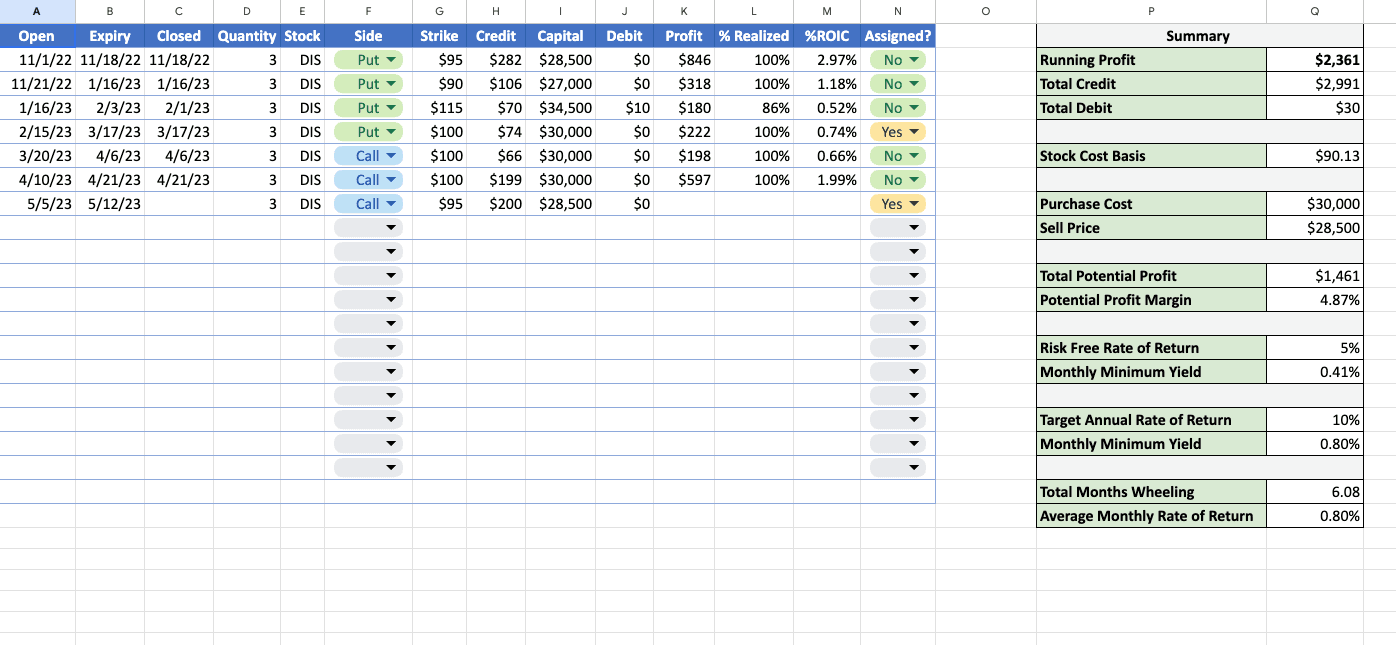
The "separate trades" problem
Every journal I've used — mine included, until now — treats a wheel like this:
- Row 1: Sold NVDA 95 CSP, expired worthless, +$180
- Row 2: Sold NVDA 100 CSP, got assigned at $100, -$500 "loss"
- Row 3: Sold NVDA 105 CC, expired worthless, +$220
- Row 4: Sold NVDA 108 CC, rolled up and out
- Row 5: Sold NVDA 112 CC, called away at $112, +$400 "gain"
Every row looks like a separate decision. The assignment looks like a losing trade. The call-away looks like a winning trade. The actual question — did this wheel beat buy-and-hold on NVDA over six months — is invisible.
I have friends who run wheels and track them perfectly. They do it in spreadsheets, by hand, and they can tell you what their ACB is at any moment because they recalculate it themselves. That's not a tool. That's unpaid accounting labor.
What Wheels does
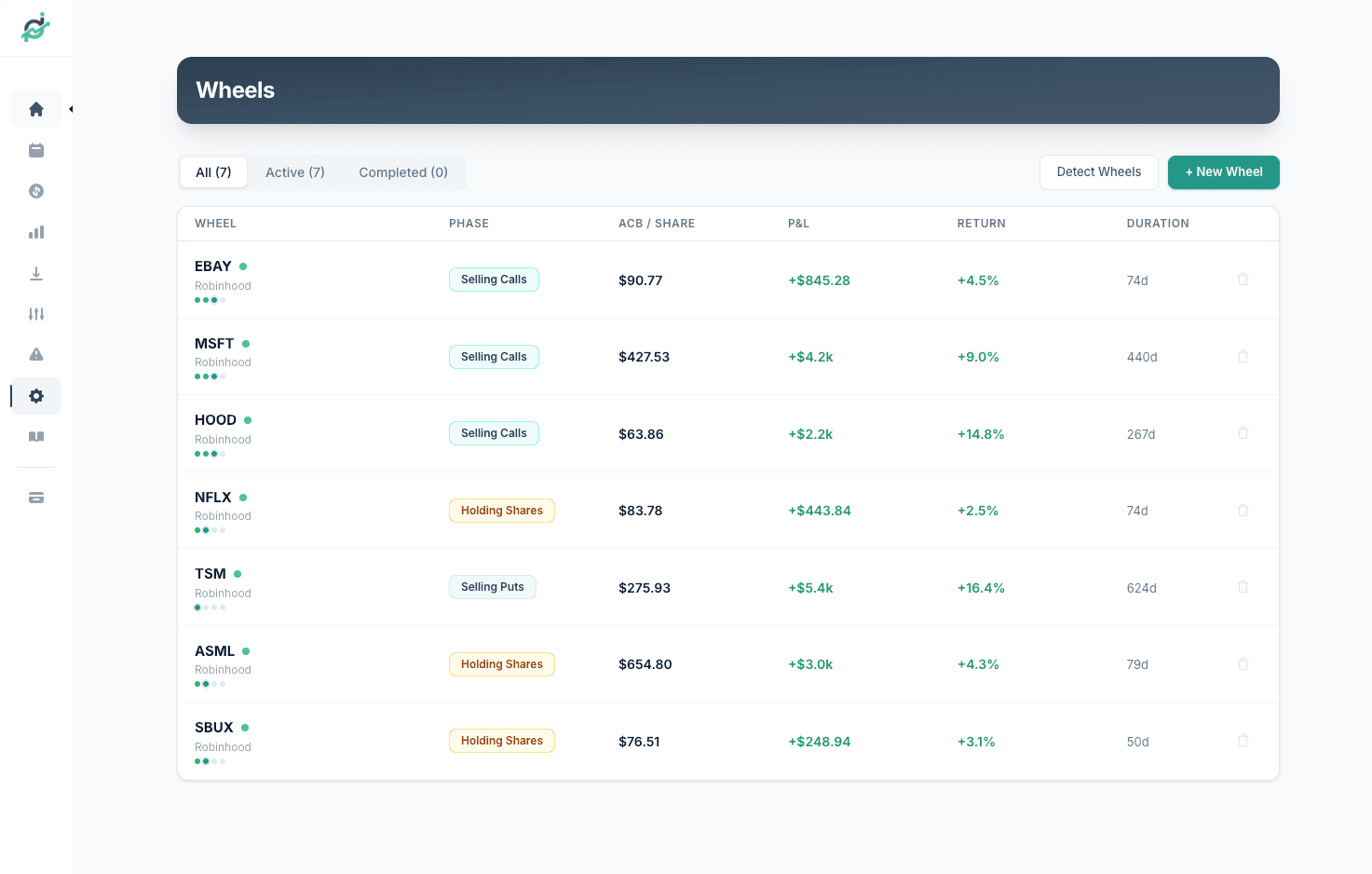
A Wheel campaign in Premium Insights is one object. It starts the first time you sell a CSP on a ticker and ends when the shares get called away or you close it out. Everything that happens in between — roll the put, get assigned, collect a dividend, sell a covered call, roll the call, get called away — becomes a leg in the same campaign.
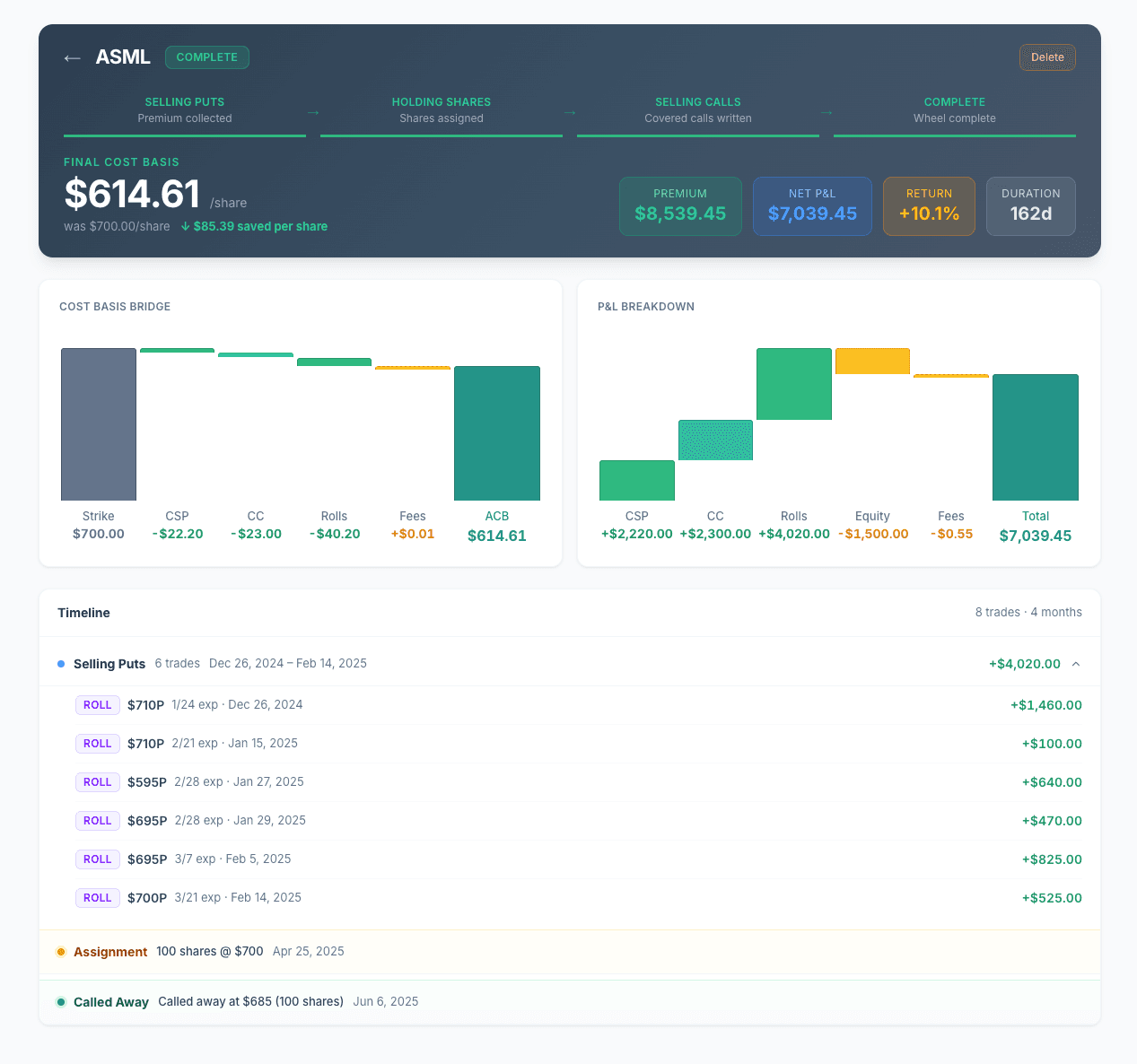
Three things happen automatically:
1. Adjusted cost basis updates at every leg. Sell a $100 CSP for $1.80, get assigned — your ACB is $98.20. Sell a $105 CC for $2.20 and it expires — your ACB drops to $96.00. Collect a $0.35 dividend — your ACB is $95.65. The number you care about is always visible and always correct, no spreadsheet.
2. The campaign shows the full P&L — not the per-leg fiction. That NVDA wheel above? In isolation the assignment looks like -$500. As part of the campaign, it's the moment your ACB dropped from $100 to $98.20 and you started collecting call premium on shares. Total campaign return of +$2,140 across six months on $10,000 of capital is a number you can actually compare to buy-and-hold.
3. Your thesis travels with the campaign. You write "I want to own NVDA under $100 for the AI capex cycle" when you open the first CSP. That thesis stays attached to every leg. Six months later when the shares get called away at $112, you can see what you were thinking at the start next to what actually happened. The reflection is on the decision that mattered — enter the wheel — not on whichever individual leg you happen to be looking at.
"Will it find my old wheels?"
Yes. This was the request we heard most in beta and it's the piece I'm proudest of.
On your next sync after today, Premium Insights scans your existing trade log for wheel patterns — sequential CSPs on the same ticker, assignment events, covered calls on the resulting shares, call-aways. When it finds a chain, it stitches the legs into a campaign and back-computes your ACB leg by leg.
If you've been running wheels in Premium Insights for a while, you'll open the app and see campaigns you didn't create. One of our beta testers had a FIG wheel going back to September 2025 — eleven legs including two rolls and three dividends — reconstructed correctly, ACB of $41.18, full P&L visible for the first time.
Detection isn't always right. A put that happens to be at the same strike as an old CSP on a stock you no longer own isn't necessarily part of a wheel. We flag low-confidence detections for review, and you can manually create, edit, or merge campaigns from the Wheels page. If auto-detection got it wrong, fix it — it's three clicks.
What it doesn't do
It doesn't tell you whether to start a wheel. It doesn't recommend strikes. It doesn't alert you when your CC is threatened.
It tells you, honestly, what your wheels are actually doing. That was the part missing.
Try it
Go to /wheels in the app. If you have existing wheel trades, you should see them reconstructed — in chronological order, with ACB computed, with your original theses attached where we could find them. If you're starting your first wheel today, open a CSP and the campaign is created automatically.
As always, if something's wrong, tell me. The detection logic is the newest code in the product and the one most likely to have edge cases I haven't seen.
I built this because I couldn't answer a basic question about my own best strategy. I hope it answers yours too.
— Credit Spread Investing
Ready to see your wheels as campaigns?
Import your trades or connect your broker and we'll stitch the cycles back together automatically.
Open Wheels